
AI Is No Longer a Tool, It's an Architecture — Why Companies Must Rethink Their Approach
Introduction
For a long time, talking about artificial intelligence in business meant talking about an assistant. A chatbot on a website. A text generator for marketing emails. One tool among many in the digital toolbox.
That era is over.
In 2025, AI is no longer just a tool you "plug into" an existing process. It has become a complex system — with its own layers of orchestration, memory, planning and governance. And like any complex system, it requires an architecture.
Companies that ignore this are not simply missing an opportunity. They are exposing themselves to concrete risks: operational chaos, costly errors, and loss of strategic control.
From assistant to system: what has changed
The chatbot era is over
Just two years ago, "implementing AI" often meant integrating a customer support chatbot or using a content generation tool. These solutions were simple, isolated, and relatively risk-free.
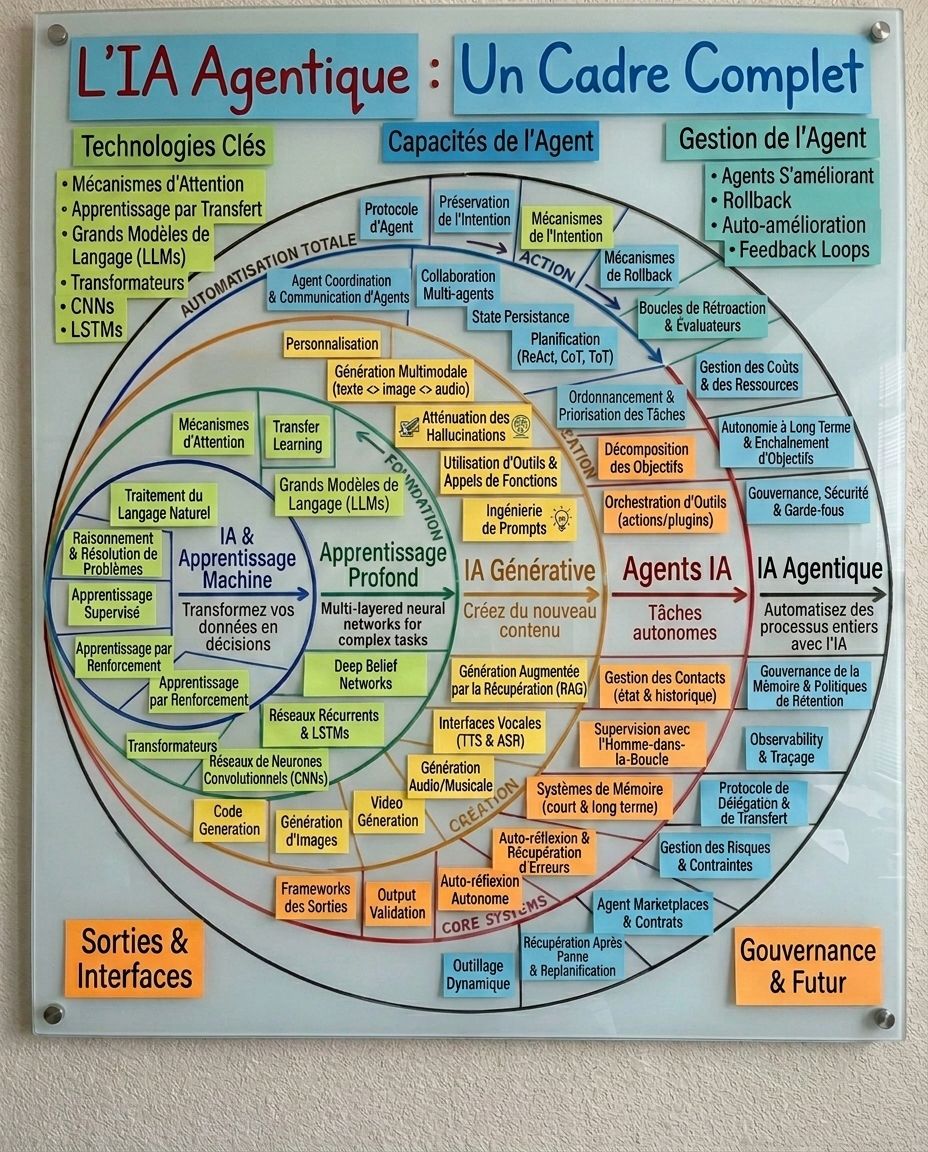
Today, the landscape is radically different. We now talk about:
- Autonomous agents capable of making decisions and executing complex tasks without human intervention
- Long-term memory allowing AI systems to retain context over weeks and months
- Multi-tool orchestration where multiple models and services collaborate in real time
- Automated strategic planning that no longer just responds but anticipates
- Risk management and governance built directly into AI pipelines
- Self-improvement through continuous feedback loops
This is no longer a tool. It is an infrastructure.
Complexity has a cost
A poorly integrated complex system does not create performance. It creates:
- Operational chaos — when AI agents interact without coordination, results become unpredictable
- Costly errors — a hallucination in a chatbot is embarrassing; in an automated decision pipeline, it can cost thousands
- Legal risks — GDPR, the Swiss DPA, and new AI regulations impose transparency and traceability obligations
- Loss of strategic control — when nobody truly understands what the AI system does, the organisation loses control
- Poorly managed technology dependency — relying on services without an exit strategy creates vulnerability
The real problem: building blocks without architecture
Many companies think they are "implementing AI." In reality, they are stacking building blocks with no master plan.
A transcription tool here. A chatbot there. A marketing automation in a corner. Three subscriptions to AI services that do not talk to each other.
The result? A proliferation of tools that are expensive, overlapping, and completely incoherent. Each department has "its own" AI, but nobody has an overall view.
AI amplifies what already exists
This is perhaps the most important reality to understand:
AI amplifies your existing organisation. If it is unclear, it amplifies the confusion. If it is structured, it amplifies performance.
A company with clear processes, solid governance and a strategic vision will derive immense benefit from AI. It will accelerate what already works.
Conversely, a disorganised company that "adds AI" will only amplify its dysfunctions — faster, at greater scale, and with less visibility.
Integrating AI: the 5 pillars of a solid architecture
Integrating AI in 2025 is not about installing a tool. It is about designing a system. And a system is structured around five fundamental pillars:
1. Strategy
Before choosing a tool, you need to answer a simple question: what business problem are we trying to solve? Too many companies start with the technology instead of the need. A clear AI strategy defines priorities, high-impact use cases, and success criteria.
2. Processes
AI integrates into existing processes — it does not replace them (at least not all of them). You need to map current workflows, identify friction points, and define how AI intervenes at each stage. Without this mapping, integration remains superficial.
3. Governance
Who oversees the decisions made by AI? What safeguards are in place? How are errors handled? AI governance is not a regulatory luxury — it is an operational necessity. It includes human validation, regular audits, and escalation procedures.
4. Security
AI systems handle sensitive data — customer data, financial information, intellectual property. Security must be built in from the design stage: data encryption, access control, regulatory compliance (DPA, GDPR), and incident response plans.
5. Long-term vision
AI evolves at a dizzying pace. What is cutting-edge today will be standard in six months. An AI architecture must be scalable — capable of integrating new models and new capabilities without rebuilding everything. This is what distinguishes a strategic investment from a one-off expense.
Why expertise has become essential
AI must not be taken lightly. It must be managed.
The democratisation of AI tools (ChatGPT, Midjourney, and hundreds of others) has created an illusion of accessibility. Yes, anyone can use a chatbot. But designing a coherent, secure AI system aligned with a business strategy? That is a profession.
That is precisely what we do at Les Précurseurs Lab. We do not sell tools — we design custom AI architectures tailored to the reality of each company.
Our approach:
- Audit of your AI maturity and existing processes
- Design of an AI architecture aligned with your business objectives
- Implementation with progressive, measurable results
- Ongoing support to evolve the system over time
Conclusion
AI in 2025 is no longer "which tool should we use?" It is "what architecture should we build?"
Companies that have understood this are gaining a decisive lead. The rest are accumulating tools, costs, and risks — without a strategy.
The question is no longer whether you should integrate AI. It is how to do it intelligently.
This article is based on our LinkedIn publication. See the original post →
Want to structure your AI approach? Contact Les Précurseurs Lab →
Find this post on LinkedIn
Join the discussion and share your thoughts.